| Parent Creature | Fated |
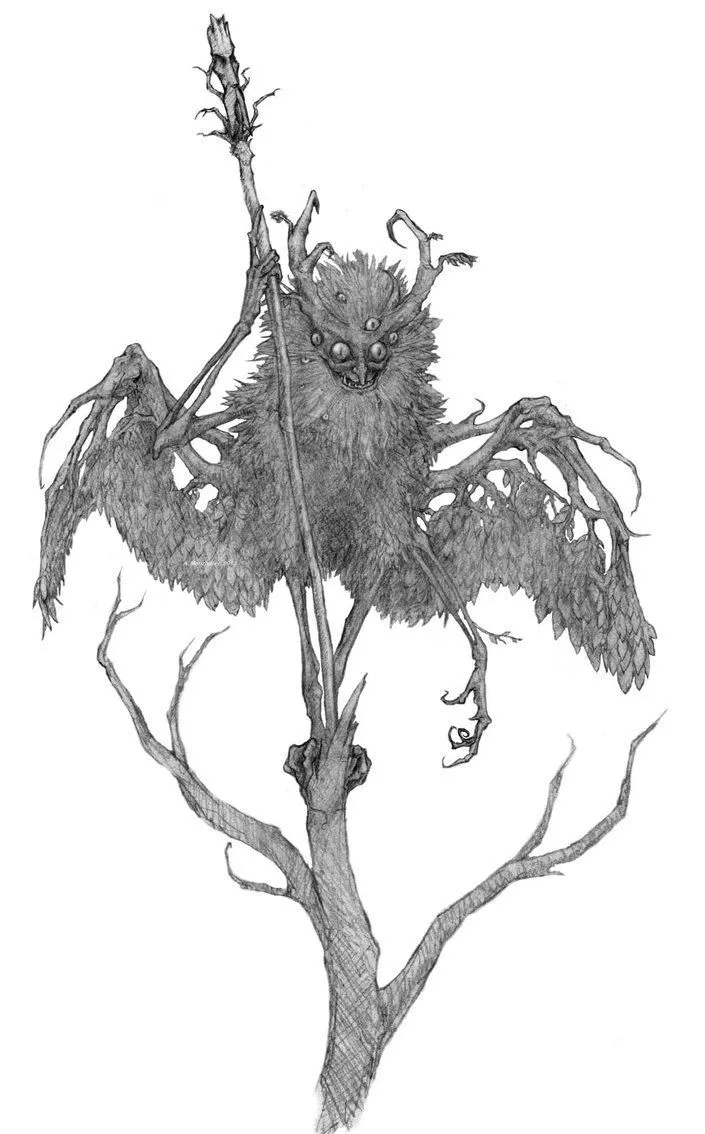
The jiki-kiji is a
Biology
The jiki-kiji is a solitary creature, not bigger than 20/30 centimeters, that can live for centuries. It usually lives in swamps and other putrid locations, but is known to move frequently. It feeds on carcasses, vegetable and fruits, which it rots for days before consuming.
Habitat
The preferred habitat fo the jiki-kiji are location where the cycle of life and death is fast, like swamps and deep forests. Thanks to its modest dimensions it easily finds home inside hollow trunks or under tree roots.
Near the nest of a jiki-kiji is common to find consumed carcasses and bones fused in impossibile ways. Coming near with the head girded with jukes is a safe way to announce that ones does not have hostile intentions and receive an audience with the jiki-kiji.
The Dead Man’s Cherry
This fruit, so bitter…
On the jiki-kiji’s head grow eyes that eventually fall like fruits from a tree. This “fruits” are known as Dead Man’s Cherries, these are bitter, and if consumed cause intoxicating visions that can give insights into the future.
Some days after falling, a hard shell develops around the Dead Man’s Cherries. After some months the fruits start to sprout and grow into common trees. A jiki-kiji can see and hear through the trees sprouted from its cherries. This is the origin of the saying: “The Forests have Eyes”.
Behaviour and Abilities
The jiki-kiji is not naturally violent and usually does not attack unprovocked. It prefers instead to converse with his potential victims and, when the time is right, push the unfortunate to their – more or less accidental – death.
On the other hand, it is not uncommon for a jiki-kiji to take liking for someone and to spare him, even if only temporarily. It loves riddles and appreciates cleverness as much as mercilessness.
Some communities can come to venerarte a jiki-kiji and bring them offers in exchange of protection.
Stitching
The jiki-kiji has the power to transfigurate the body of living creatures, by fusing them with others, in a process they call stitching. These alterations present themsevels with visibile stitches with the texture and color of tree branches and vines. In exchange for its services, a jiki-kiji can ask for favors or body parts.
In the centuries, many have been altered by the jiki-kiji, some for vanity, some in search of power. Almost everyone who undergoes stitching becomes an aberration, loses its mind and becomes a servant of the jiki-kiji.
Ringmakers
The jiki-kiji are also